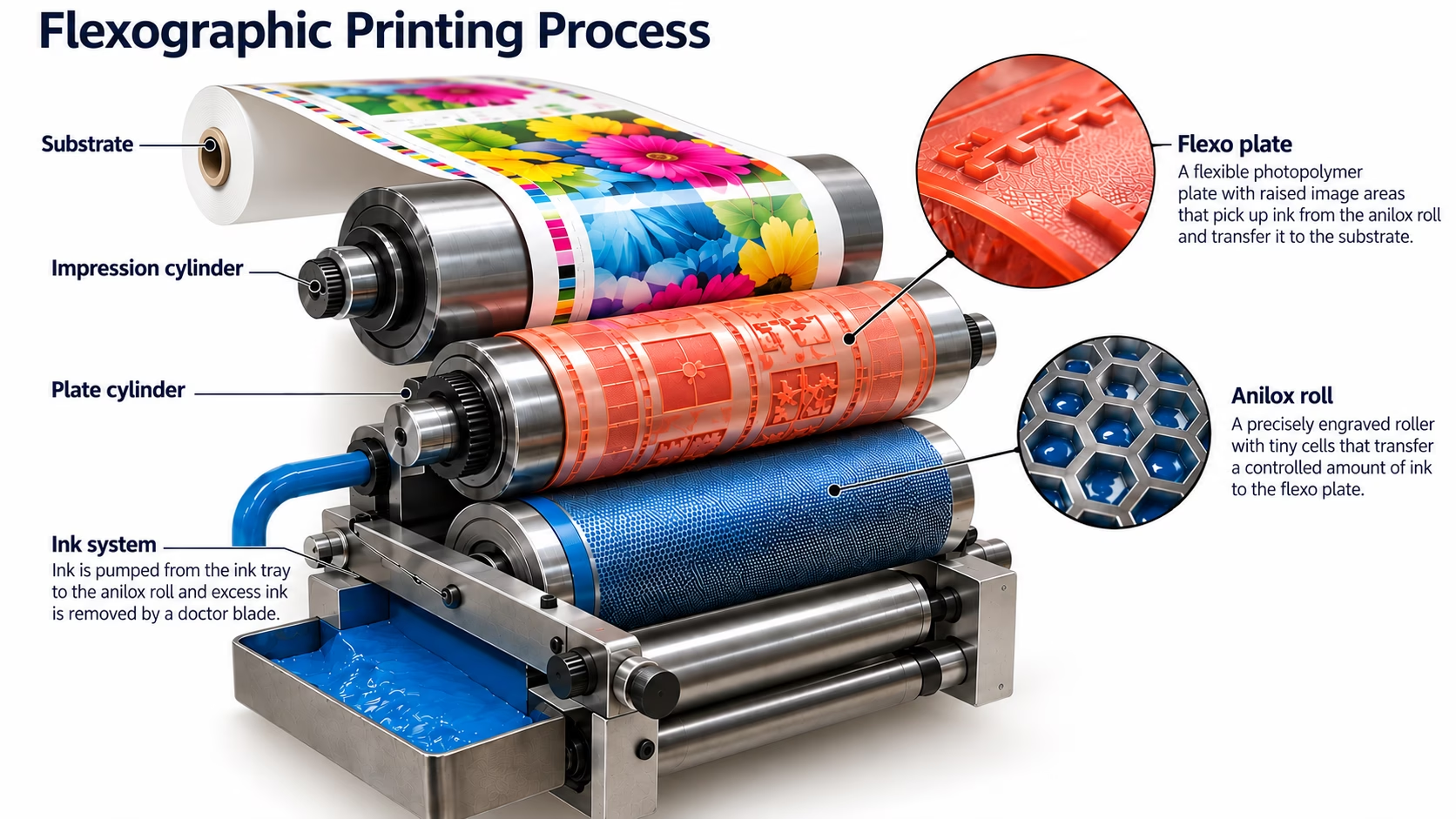
What is Flexography printing?
We compare here the difference between Flexography and Lithography
Flexography (often called Flexo printing) is a high-speed printing process that uses flexible relief plates made from rubber or photopolymer. Ink is transferred from an ink roller (anilox roller) to the raised areas of the printing plate, which then prints the image onto a wide variety of materials. The name flexography comes from the flexible, raised-relief printing plates used in the process.
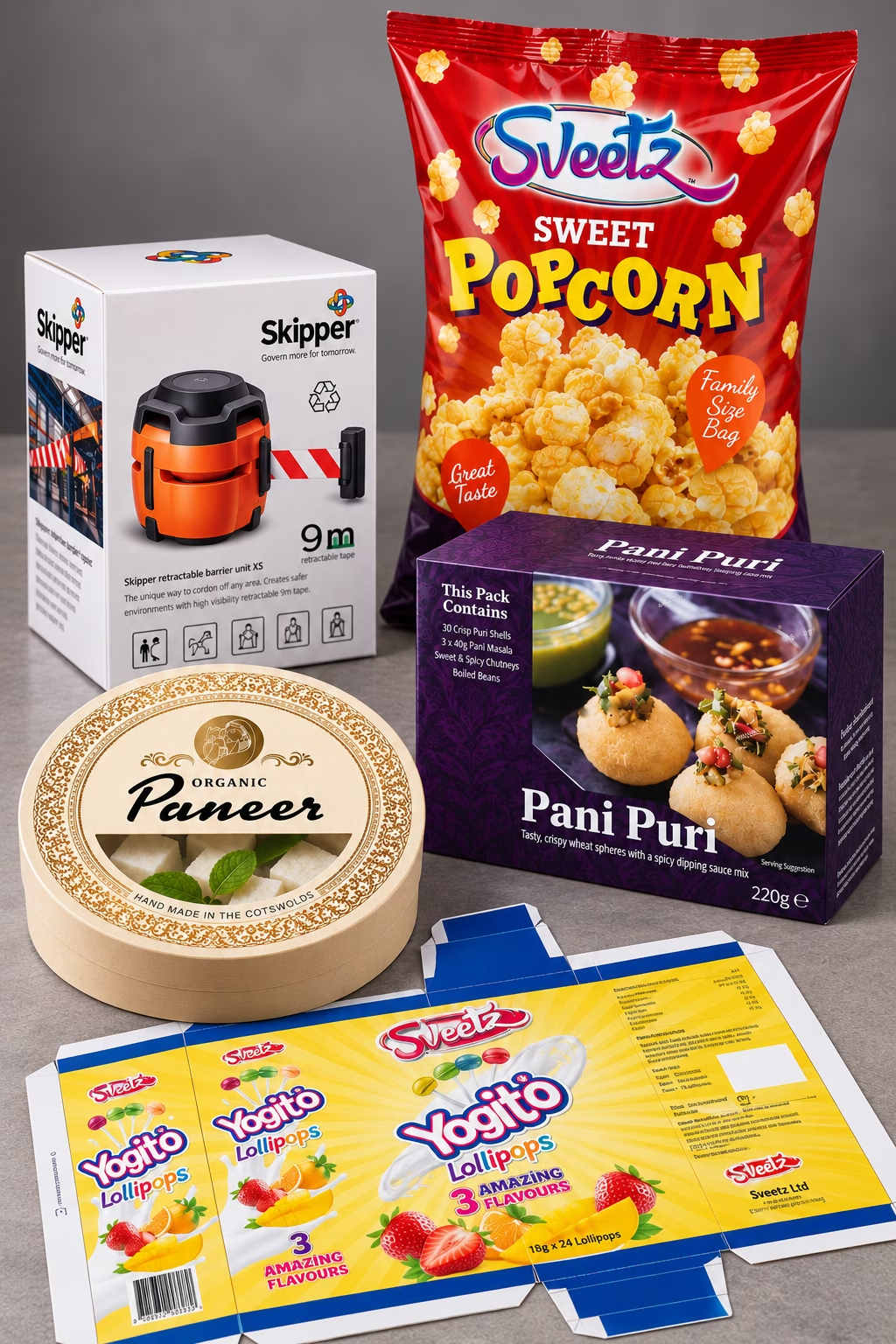
It is widely used for packaging and labels because it can print on materials that are difficult for other printing methods, such as plastic films, foil, cardboard, corrugated boxes, and paper. It offers outstanding results and quality.
Flexography
- Uses flexible raised printing plates (relief printing).
- Prints well on rough, flexible, and non-porous materials such as plastic, film, foil, and board.
- Uses fast-drying inks, making it ideal for high-speed production.
- Primarily used for packaging, labels, and flexible packaging.
- Excellent for large-volume packaging runs.
Lithography (Offset Printing)
- Uses flat printing plates based on the principle that oil and water repel each other.
- smooth, high-quality papers like silk, gloss, or uncoated stock.
- Produces very high image quality with sharp detail and smooth colour gradients.
- Commonly used for books, magazines, brochures, catalogs, and marketing materials.
- Excellent for high-quality commercial printing.
Examples of Flexography printing
Flexography is commonly used to print:
- Food packaging
- Plastic bags
- Product labels
- Corrugated shipping boxes
- Folding cartons
- Gift wrap
- Tissue paper
- Paper napkins
- Shopping bags
- Envelopes
- Ice cream cartons
- Disposable paper plates and cups
- Flexible pouches
- Adhesive tapes
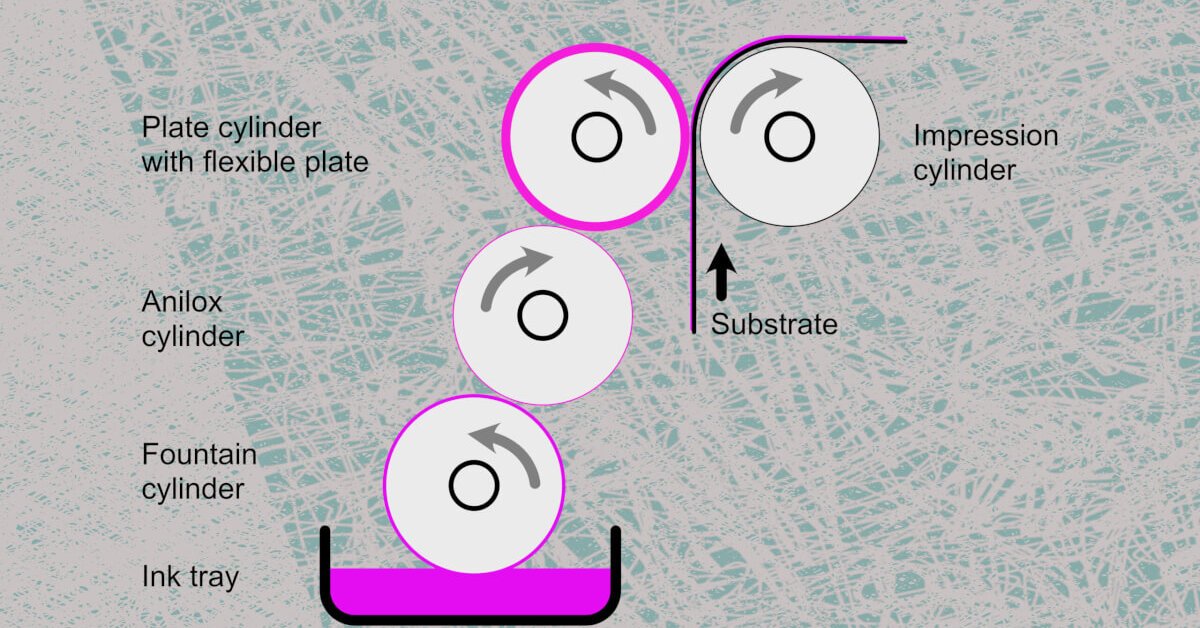
Above: The flexographic printing process. Ink is added to the ink tray, where the fountain cylinder picks up the ink and transfers it to the anilox cylinder. A doctor blade, not shown, removes excess ink from the anilox, leaving a controlled amount of ink within its microscopic cells. The anilox then transfers the ink to the raised image areas of the flexible flexographic plate mounted on the plate cylinder.
The substrate passes between the plate cylinder and the impression cylinder. The impression cylinder applies controlled pressure to the substrate as it passes through the nip, allowing the raised areas of the flexographic plate to transfer the ink and create the printed image.
What is a Flexo printing press?
A flexographic printing press is a substantial printing machine composed of flexible plates and rollers. Traditionally, printers utilised rubber Flexo plates; however, advancements in technology have led to the use of flexible photopolymer wrapped around a roller. Essentially, a Flexo printer functions similarly to a large stamp, capable of printing at speeds of up to 2,000 feet per minute.
There are five distinct types of Flexographic printing presses:
- Stack Press: This type features vertically stacked decks that enable printing on both sides of the substrate.
- Central Impressions Press: This design includes a central impression cylinder.
- In-Line Press: The decks are arranged in a horizontal line, facilitating easier operations.
- Wide-Web Press: This Flexo press is specifically designed to accommodate wider rolls of substrates.
- Narrow-Web Press: This variant is tailored for handling smaller substrates, such as labels.
How it works
As you can see from the main image; A flexible photopolymer plate is wrapped around a rotating cylinder for each colour. In a manner akin to the letterpress printing technique, the graphics and text for each colour are raised above the surface of the plate.
Only the elevated portions of the plate are inked. A typical flexographic press is composed of four types of rollers: a fountain roller, an Anilox roller, the plate cylinder, and the impression cylinder.
The fountain roller conveys ink from an ink pan to a steel or ceramic ink-metering Anilox roller, which subsequently transfers it to the plate cylinder. As the paper passes between the plate cylinder and a polished metal impression cylinder, the ink is applied to the substrate. The impression cylinder applies the necessary pressure to ensure the ink is successfully transferred from the plate to the substrate.
In Flexography, the Anilox roller plays a vital role in providing a uniform thickness of ink to the flexible printing plate. Each Anilox roller is equipped with finely engraved cells that are designed to retain a specific volume of ink. An optional doctor blade may be employed to scrape the surface of the Anilox roller, guaranteeing that only the ink stored in the engraved cells is transferred to the printing plate.
Flexographic Prepress
What are the key differences in prepress when dealing with Flexo?
Prepress for flexographic printing (Flexo) requires specialised file preparation to compensate for the characteristics of flexible printing plates and compressible substrates. Unlike lithographic (offset) printing, where artwork is generally reproduced at its exact dimensions, flexographic prepress involves intentional adjustments to account for plate distortion, dot gain, and registration variation.
Both flexographic and lithographic prepress workflows require standard prepress practices such as checking artwork resolution, bleed, and trapping. However, trapping strategies differ significantly because of the physical behaviour of the printing plates used in each process.
Why trapping strategies differ
Lithographic Printing
Lithographic printing uses rigid aluminium plates that maintain excellent dimensional stability throughout the printing process. Because the plates do not stretch or compress, colour registration is highly accurate. As a result, only minimal trapping is required, with trap widths typically small enough to remain invisible in the final print.
Flexographic Printing
Flexographic printing uses soft photopolymer relief plates that wrap around a printing cylinder. During printing, these plates compress under impression pressure, which can cause slight image distortion and registration variation. To prevent unwanted white gaps between adjacent colours, prepress operators apply larger trap values by slightly extending one colour into another. These wider traps compensate for plate movement and ensure clean colour transitions.
When artwork originally prepared for lithographic printing is converted for flexographic production, the prepress files must be modified to increase trapping and compensate for plate distortion and compression.
File preparation and compensation
Flexographic Printing
Artwork prepared for flexographic printing cannot be reproduced literally. As the flexible plate is mounted around a cylinder, it experiences elongation and compression during production. To maintain correct printed dimensions, prepress operators apply distortion compensation by adjusting the artwork in the direction of cylinder rotation. Additional trapping is also applied to minimise visible registration errors caused by plate movement or press variation.
Lithographic Printing
Lithographic artwork is prepared at its final intended size with little or no geometric compensation. Since the image transfers from a rigid aluminium plate to a rubber blanket before being printed onto the substrate, dimensional changes are negligible. This allows for highly accurate registration and faithful reproduction of the original artwork.
Dot gain and screening
Flexographic Printing
Flexographic presses use liquid inks and direct impression pressure, causing printed halftone dots to spread as ink transfers to the substrate. This phenomenon, known as dot gain, can result in darker images and reduced detail if left uncorrected.
To compensate, prepress operators apply dot gain compensation curves and generally use lower line screen frequencies (LPI), ensuring tonal values reproduce accurately while maintaining print stability across a range of packaging substrates.
Lithographic Printing
Lithographic printing experiences lower and more predictable dot gain due to its indirect offset printing process and controlled ink transfer. This allows significantly higher line screen frequencies to be used, producing sharper images, finer typography, smoother gradients, and superior photographic reproduction.
Print plate technologies
Flexographic Printing
Flexography uses flexible, raised photopolymer plates that receive ink from an anilox roller before transferring it directly to the substrate. During prepress, plate thickness, distortion compensation, screening, and relief characteristics must all be considered to achieve accurate print reproduction.
Lithographic Printing
Lithographic printing uses flat aluminium plates that are chemically processed so that image areas attract oil-based ink while non-image areas attract water and repel ink. The prepress process focuses on precise plate imaging, calibration, and colour management to ensure accurate reproduction throughout the print run.
Finally
Although both flexographic and lithographic printing rely on core prepress principles such as bleed, trapping, colour management, and file verification, the physical characteristics of each printing process require different preparation techniques. Flexographic prepress involves compensation for plate distortion, increased trapping, and dot gain correction, whereas lithographic prepress prioritises dimensional accuracy, fine screening, and precise colour consistency due to the stability of its printing plates.
Flexography is best for fast, cost-effective printing on packaging materials and non-paper surfaces.
Lithography is best for high-resolution printing on paper products where image quality is the top priority.
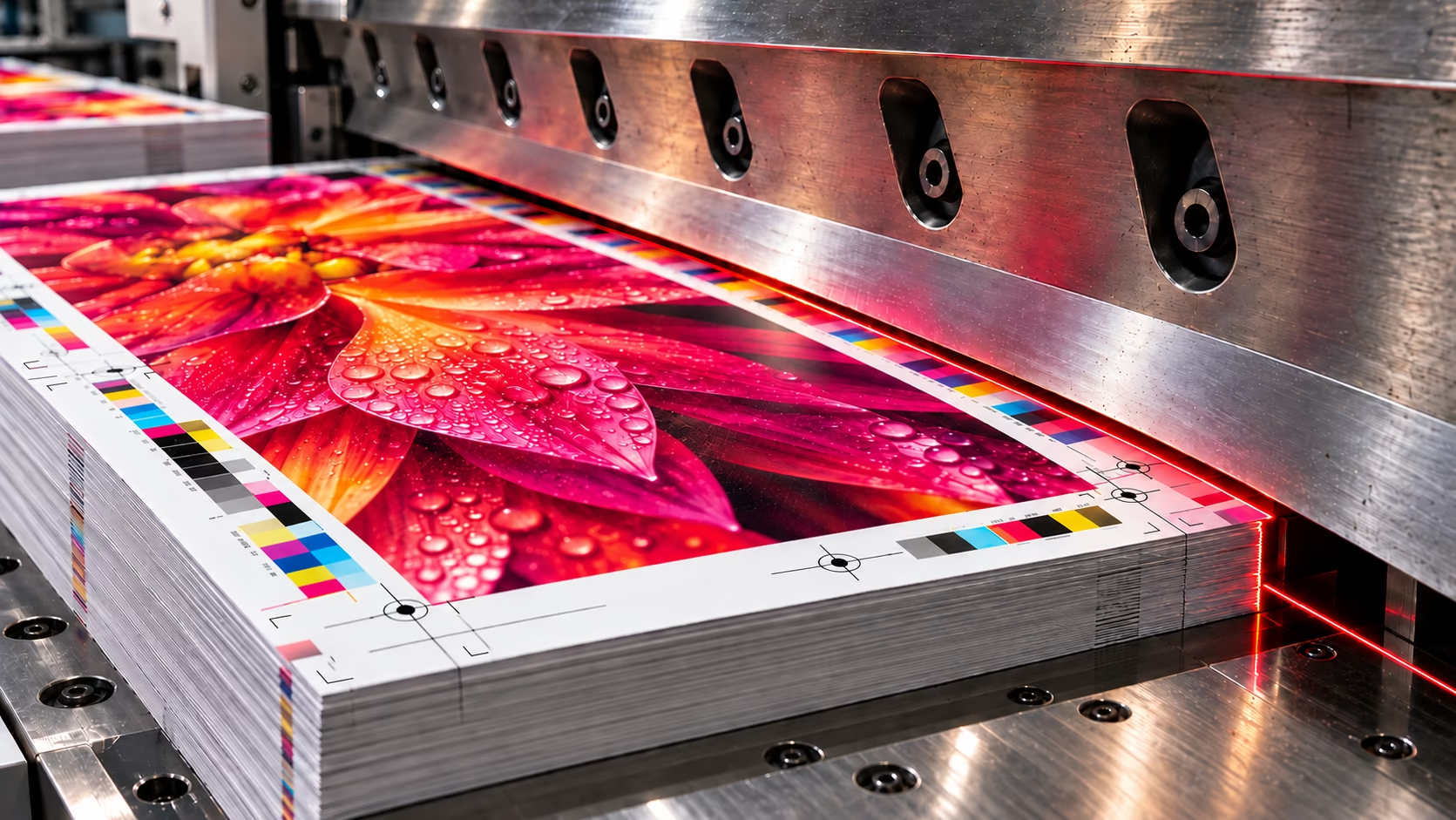
Explore the world of Prepress


Read More
https://en.wikipedia.org/wiki/Flexography